.svg)

A Company Just Promised $1M Salaries for Tokenmaxing
Last week a CEO said he fired his entire HR team. This week a different CEO laid off 22% of his company and told the people who stayed they could earn a million dollars a year.
Same week. Very different playbooks. And the second one is the one you should actually be worried about, because it's coming for your comp model.
__________________________________________________________________________________
Here's what happened.
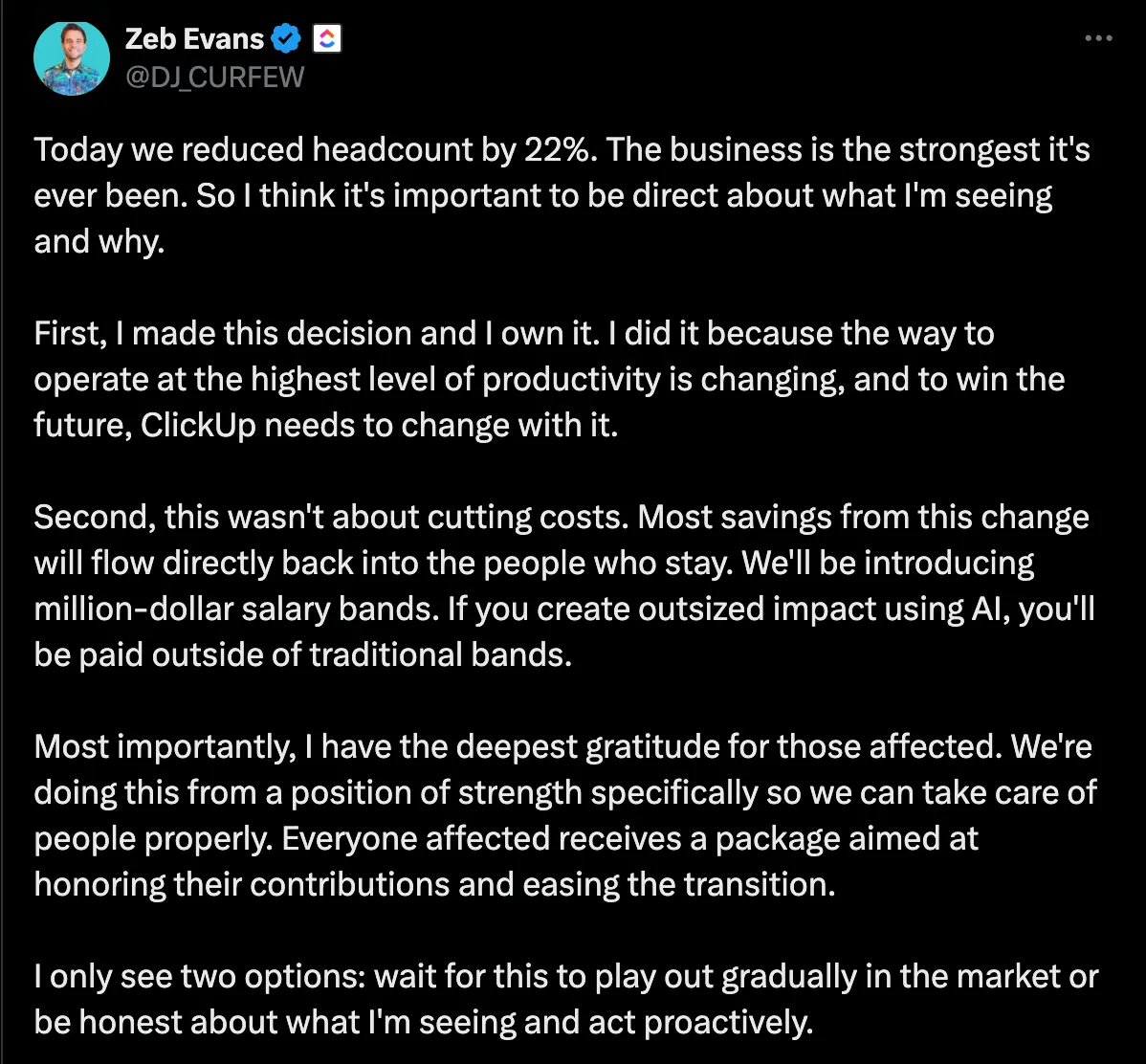
On May 21, ClickUp CEO Zeb Evans posted on X that the company had cut 22% of its workforce. ClickUp is a $4 billion productivity platform with around 1,300 employees before the cut. Evans was direct: "The business is the strongest it's ever been. I made this decision and I own it."
Then he said the part that should have every comp leader in the country paying attention: "Most savings from this change will flow directly back into the people who stay. We'll be introducing million-dollar salary bands."
The condition: "If you create outsized impact using AI, you'll be paid outside of traditional bands."
Let me explain why this matters more than the Bolt story.
Breslow fired his HR team at a company that lost 97% of its value. That's a crisis move being justified as a philosophy. You can disagree with it and move on.
ClickUp is different. This is a company operating from strength, making a structural bet on a model they're calling the "100x org." The premise: AI agents have changed what it takes to build software, and the roles required to operate at the highest level are fundamentally different now. Evans isn't cutting costs. He's redesigning what a company looks like when AI agents outnumber employees.
And at ClickUp, they already do. A Fortune profile published days before the layoffs revealed that ClickUp runs roughly 3,000 internal AI agents across its departments. That's a 3:1 ratio of agents to employees.
__________________________________________________________________________________
The "100x org" breaks employees into three categories.
Builders. The best engineers and product people who don't write code anymore. They direct AI agents that write code. The skill that matters is judgment: the ability to orchestrate and review what the agents produce.
System Managers. People who oversee and improve the AI systems themselves. They're responsible for making sure the agents are doing what they're supposed to be doing, catching errors, and improving the workflows.
Front-Liners. The one category Evans said AI cannot replace: direct customer interaction. As AI-generated communication floods the market, genuine human engagement becomes a premium.
That's the whole org. Three roles. Everyone else is either in one of those categories or they're in the 22% that just left.
__________________________________________________________________________________
Here's the question this forces onto every HR leader's desk: what do your comp bands look like when one person managing AI systems produces the output of ten?
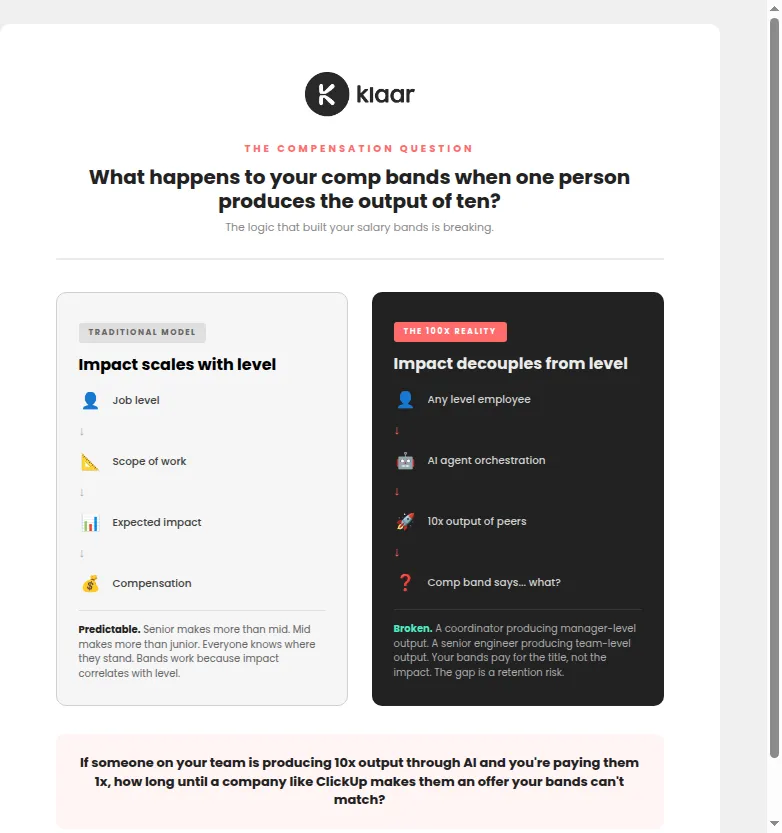
Traditional salary bands are built on a set of assumptions. Job level maps to scope. Scope maps to impact. Impact maps to compensation. Senior engineer makes more than mid-level engineer because they handle more complex problems with less supervision.
That logic breaks when a senior engineer with AI agents can produce what a team of five produced last year. The impact has decoupled from the job level. One person's output now looks like a department's output. And if you don't pay them like they're irreplaceable, someone else will.
Evans is making a bet that the war for talent in 2026 and beyond is not about headcount. It's about the small number of people who can orchestrate AI systems for disproportionate impact. And he's willing to pay those people a million dollars a year in cash, not equity, not options, cash, because losing one of them costs more than keeping ten average performers.
__________________________________________________________________________________
I showed this to Noor. Her first question: "Could we do this?"
My honest answer: not yet. And probably not ever in exactly this form, because ClickUp is a software company with 1,300 people and Meridian is a healthcare company with different economics. But the underlying logic applies everywhere.
If someone on your team is managing AI workflows that produce ten times the output of their peers, and you're paying them the same as their peers because the salary band says so, you have a retention time bomb. It's only a matter of time before a ClickUp or a company like it comes recruiting with compensation that your bands can't match because your bands weren't designed for this world.
Three things I'm doing at Meridian this quarter:
Auditing for disproportionate impact. Who on our team is producing outsized results because of how they use AI? Not who's the best performer in the traditional sense. Who has figured out how to use AI as a multiplier in ways their peers haven't? Those people need to be identified, recognized, and compensated before they get a recruiter's DM from a company that will.
Stress-testing our comp bands. Do our bands have room for someone whose impact has decoupled from their job level? If a coordinator-level employee is producing manager-level output because of how they use AI, do our bands allow us to pay them for the output or only for the title? Most bands don't. That's the gap.
Having the honest conversation with finance. The ClickUp model works because they're reinvesting layoff savings into remaining employee compensation. That's a CFO conversation. If we're going to retain the people who are driving disproportionate impact with AI, the money has to come from somewhere. "Pay them more" is easy to say. "Here's where the budget comes from" is the actual conversation.
__________________________________________________________________________________
The Bolt story last week was about whether HR should exist. That's the wrong question. This week's question is harder: does your compensation model still work when AI makes one person worth ten?
If you don't have an answer, start with those three steps. Because Evans said something in his post that I think is right: "Nearly every company will make changes like these. The ones that do it proactively will define what comes next."

.svg)

.svg)