.svg)

Does your CEO agree with Bolt’s Ryan Breslow?
Seventeen people sent me the Bolt clip last week. I watched it once and closed my laptop. Then I opened it and watched it again because I needed to understand why it made me so angry before I could say anything useful about it.
If you haven't seen it: Ryan Breslow, CEO of Bolt, stood on stage at Fortune's Workforce Innovation Summit and said he fired his entire HR team because they were "creating problems that didn't exist." His exact words: "Those problems disappeared when I let them go."
This episode is about what every HR leader should actually take from that moment, beyond the outrage.
__________________________________________________________________________________
His take was flawed. Firing your entire HR team is not a leadership strategy. It's what happens when a CEO never understood what the function was supposed to do in the first place.
Some context that most of the outrage posts are skipping. Bolt's valuation dropped from $11 billion in 2022 to roughly $300 million by 2024. That's a 97% decline. Breslow stepped down as CEO in 2022, came back in 2025, and found a company he described as bloated and complacent. He cut 30% of the workforce in April. The company went from roughly 800 people to about 100. At that size and that level of crisis, a traditional HR department with specialists across talent acquisition, L&D, total rewards, and business partnering doesn't make operational sense.
And here's what the headlines are burying: he didn't eliminate the People function. He replaced a full HR team with a two-person people ops team focused on compliance and training. That part is not controversial. Plenty of 100-person startups run with a lean people ops setup.
The problem is the framing.
Saying HR was "creating problems that didn't exist" tells every employee at every company that HR is overhead. It tells every CEO who's already skeptical that their instinct was right. It gives permission to gut the function without understanding what it does. And it ignores the most obvious question: if your HR team was creating problems, whose job was it to manage them? The CEO's. Breslow is blaming the output of a function he was responsible for leading.
That's like a CFO saying "our finance team was producing inaccurate forecasts so I fired them all." The forecasts were inaccurate because you weren't managing the team. The answer is better leadership, not elimination.
__________________________________________________________________________________
But I want to be honest about something, and I know this is going to be uncomfortable.
The outrage is easy. Every HR leader I know reposted the clip with some version of "this is why companies fail." And they're right. But the harder question is the one nobody in my DMs is asking.
What if some version of this criticism is sitting quietly in your CEO's head right now?
Not the firing part. Not the "problems that didn't exist" part. But the underlying question: is our HR function producing value that I can see and measure, or is it producing activity that feels important but doesn't move the business?
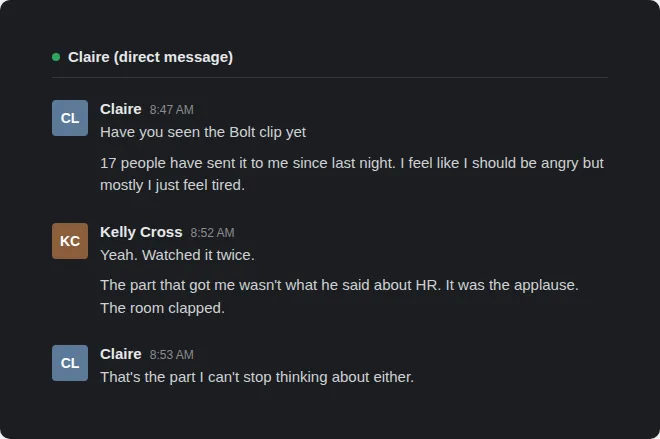
I came back from my week off to this clip. And it hit different after a week where I wasn't here and the function ran without me. Claire handled everything. Nothing broke. That's a credit to how we've built the team. But it also forced me to sit with a version of Breslow's question applied to myself: if the CPO disappears for a week and nothing breaks, what is the CPO actually for?
The answer, for me, is that my value is in the strategic work that doesn't produce visible output on a weekly basis. Organizational design. Compensation philosophy. Leadership development architecture. CEO partnership on decisions that affect every employee. That work compounds over months, not days. But if I'm honest, I haven't always been good at making that value visible.
__________________________________________________________________________________
So here's what I'm doing this week, and what I think every HR leader who watched that clip should do too.
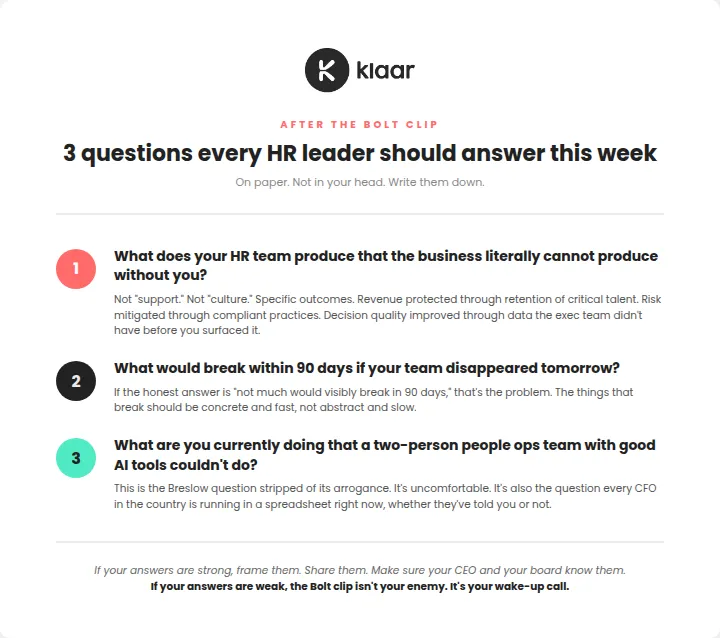
Three questions. Answer them honestly. Write down the answers. Not in your head. On paper.
What does your HR team produce that the business literally cannot produce without you? Not "support." Not "culture." Not "employee experience." Specific outcomes. Revenue protected through retention of critical talent. Legal risk mitigated through compliant practices. Decision quality improved through data the exec team didn't have before you surfaced it. If you can't name specific outcomes, your CEO can't see them either.
What would break within 90 days if your team disappeared tomorrow? If the honest answer is "not much would visibly break in 90 days," that's the problem. The things that break should be concrete and fast, not abstract and slow. If your value only becomes visible after six months of decay, you have a visibility problem.
What are you currently doing that a two-person people ops team with good AI tools couldn't do? This is Breslow's question stripped of its arrogance. It's uncomfortable. It's also the question every CFO in the country is running in a spreadsheet right now, whether they've told you or not.
If your answers are strong, you have nothing to worry about. Frame them. Share them. Make sure your CEO and your board know them.
If your answers are weak, the Bolt clip isn't your enemy. It's your wake-up call.

.svg)

.svg)