.svg)


The Most Overused Phrases in Performance Reviews (And What They Actually Mean)



Overview
Performance reviews are designed to help employees grow.
But too often, the feedback employees receive creates more questions than answers. Broad phrases like "needs to be more strategic" or "could improve communication" have become staples of performance reviews, yet they rarely provide the clarity employees need to improve with confidence.
This month's blog explores why these common performance review phrases often miss the mark, what managers usually mean when they use them, and how more specific, continuous feedback can transform performance conversations from vague evaluations into meaningful coaching.
Every performance review is supposed to answer one fundamental question.
What should this employee do to become even more successful moving forward?
At least, that's the goal.
In reality, many review conversations focus far more on documenting the past than preparing employees for the future. Managers summarize accomplishments, identify development areas, assign ratings, and close the conversation. Employees walk away with feedback, but not always with direction.
According to Gallup, only 2 in 10 employees say their performance is managed in a way that motivates them to do outstanding work. While there are many reasons behind that number, one common challenge is that feedback often identifies an opportunity for improvement without explaining what improvement actually looks like.
That's where performance reviews begin to lose their value.
Managers know exactly what they mean when they write comments like:
"Needs to be more strategic."
"Could improve communication."
"Shows great leadership potential."
"Needs to take more ownership."
Employees, however, are often left translating those phrases into something actionable.
After years of leading teams, and now seeing thousands of performance conversations happen through Klaar, I've noticed that the strongest managers don't necessarily give more feedback. They create more clarity.
They coach continuously throughout the year, making formal reviews less about explaining the past and more about aligning on what's next.
Here are six performance review phrases I think we should start retiring.
1. "Needs to Be More Strategic"
This is one of the most common pieces of feedback managers give, and one of the least understood.
Does it mean thinking further ahead? Prioritizing differently? Connecting work to business goals? Making better decisions?
Without context, employees are left guessing.
Instead of saying:
"I'd like you to be more strategic."
Try:
"You've done a great job executing projects. The next step is spending more time explaining why this work matters, what tradeoffs you're considering, and how your recommendations support our larger goals."
Specific feedback gives employees something they can actually practice.
2. "Could Improve Communication"
Communication has become one of performance management's biggest catch-all phrases.
Communicating with customers isn't the same as communicating with executives. Leading meetings isn't the same as writing project updates.
Before using this phrase, ask yourself:
- Who does communication need to improve with?
- What specifically isn't working?
- What behavior would success look like?
Instead of saying:
"Work on your communication."
Try:
"I'd like stakeholders to hear about project risks earlier instead of during status meetings. Sending a quick update when priorities change will help everyone stay aligned."
Employees shouldn't have to interpret feedback before they can act on it.
3. "Needs More Executive Presence"
Executive presence is one of the most subjective phrases in the workplace.
For some managers, it means confidence. For others, brevity, influence, or stronger decision-making.
The problem is that employees can't improve something that hasn't been clearly defined.
Instead of saying:
"Work on your executive presence."
Try:
"I'd like to see you state your recommendation earlier in meetings instead of waiting until the discussion is almost over. Your ideas are strong, and I want people to hear them sooner."
Describe the behavior, not the label.
4. "Needs to Take More Ownership"
Ownership isn't a personality trait. It's a collection of behaviors.
For many managers, ownership means:
- Identifying risks before someone asks.
- Following through without reminders.
- Bringing possible solutions instead of only raising problems.
- Closing communication loops with stakeholders.
Instead of saying:
"I'd like you to take more ownership."
Try:
"When challenges come up, I'd love to see you recommend a path forward instead of waiting for direction. You have good instincts. Trust them."
Coaching behaviors is always more effective than assigning labels.
5. "Great Team Player"
Even positive feedback can be too vague.
When someone is described as a "great team player," what exactly should they continue doing?
Were they collaborative?
Did they mentor others?
Did they keep cross-functional projects moving?
Recognition is most valuable when it's as specific as developmental feedback.
Instead of saying:
"You're a great team player."
Try:
"The way you consistently jump in to help teammates before deadlines, and keep everyone informed along the way, has made several cross-functional projects run much more smoothly."
Specific praise reinforces the behaviors you want to see again.
6. "Exceeded Expectations"
Everyone wants to hear this. But exceptional performance shouldn't be a mystery.
Instead of simply telling employees they exceeded expectations, explain why.
Was it their leadership?
Decision-making?
Customer relationships?
Ability to navigate ambiguity?
The clearer managers are about what drove success, the easier it becomes for employees to repeat it.
Recognition shouldn't just celebrate great work.
It should create a blueprint for future performance.
Better Feedback Starts Long Before Review Season
None of these phrases are inherently wrong.
The problem is that they're often expected to carry the weight of months of coaching in a single conversation.
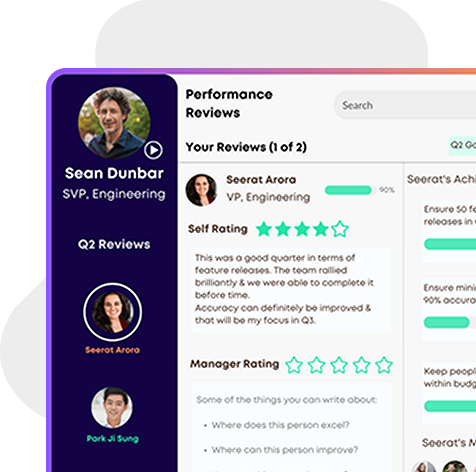
The strongest organizations don't rely on annual or mid-year reviews to create clarity. They build it continuously. Expectations stay visible. Feedback happens in the moment. Managers coach throughout the year instead of saving development conversations for review season.
When that happens, formal reviews become far more valuable. Instead of introducing new expectations, they reinforce progress, celebrate growth, and align on what's next.
Wrapping Up
Performance reviews shouldn't be the first time employees understand what's expected of them.
They should be a checkpoint, not a surprise.
The organizations creating the strongest performance cultures aren't simply giving more feedback. They're creating more visibility, more consistency, and more clarity throughout the year.
At Klaar, we believe performance works best when expectations, feedback, and progress remain visible long before a formal review takes place. When employees always know where they stand, review conversations become opportunities to accelerate growth instead of decode vague feedback.
Because when expectations are clear, employees don't just perform better.
They perform wonders.
If you're thinking about how performance conversations are evolving inside your organization, I'd love to hear what's working for your teams. Connect with me on LinkedIn so we can continue advancing how performance really works.
With Clarity,
Lana Peters
Chief Revenue & Customer Experience Officer
.svg)
Frequently asked questions


.svg)

.svg)