.svg)

Your Managers Have a Very Different Role Now. And it’s Burning Them Out
This is Kelly, writing to you directly. I missed last week. I'd love to tell you it was because I was at a conference or on vacation, but the truth is I was sitting in my car in the Meridian parking garage at 8pm on a Tuesday, staring at my phone, trying to figure out how to tell Noor that the AI org redesign we spent two months on just broke our best managers.
I'm sending this on Friday instead of Tuesday because the last ten days have been a blur, and I'm only now clear-headed enough to write about what happened. If you want to skip directly to the good part, here’s the Manager Operating System I built for managers navigating an AI org-redesign.
If you've ever had a quarter where everything looked great on the dashboard and terrible in the hallways, you'll recognize this one.
__________________________________________________________________________________
It started with a Slack notification I almost ignored.
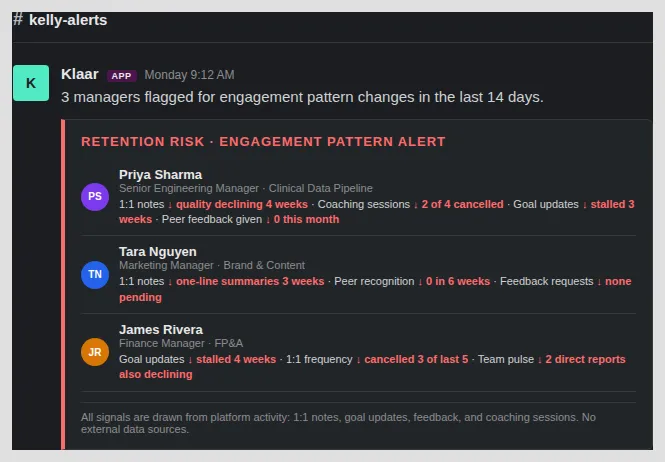
Three managers flagged in the same two-week window. All high performers. All in functions that went through the AI org redesign. The system was surfacing a pattern I hadn't been watching for: 1:1 note quality declining, coaching sessions cancelled, goal updates stalled, peer feedback given dropping to zero. None of these signals are alarming on their own. Together, they tell a story.
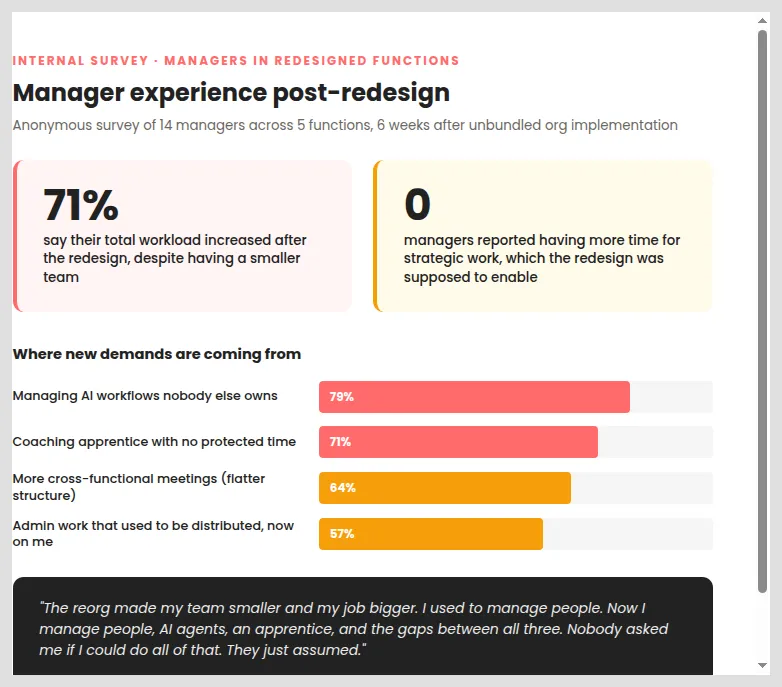
Priya had been one of our strongest managers before the redesign. In the old structure, she managed eight engineers. After the unbundled org exercise, her team was restructured to five engineers plus AI workflows plus one apprentice. On paper, it was a leaner, more leveraged team. In practice, Priya was now doing five jobs.
She was still managing the five engineers. She was overseeing the AI workflows nobody else understood well enough to own. She was coaching an apprentice who, by design, was not supposed to produce output but was supposed to learn by working alongside Priya. She was attending the new cross-functional integration meetings that the flatter structure required. And she was trying, somehow, to also do the strategic engineering work that the leverage lens said she should be freed up to do.
The redesign gave Priya more leverage on paper. In reality, it gave her more responsibility with no additional support.
__________________________________________________________________________________
I went to Dev first. "I need to talk to you about Priya," I said.
His face changed immediately. "She's leaving?"
"She hasn't said that. But the signals are there. And it's not just her. I'm seeing the same pattern across multiple functions."
Dev sat down. He was quiet for a long time. Then he said something I wasn't expecting.
"Kelly, I know. I've known for weeks. I didn't say anything because I thought it was a transition pain. New structure, new rhythms, takes time to settle. But it's not settling. She told me that she's exhausted. She said, and I'm quoting: 'Dev, I'm doing the job of three people and being evaluated on the job of one.'"
That sentence hit me in the chest.
The framework we built looked at functions through four lenses: tasks, leverage, capability, economics. Not one of those lenses asked: "What is the experience of the manager who has to operate inside this redesigned system?"
__________________________________________________________________________________
I spent the rest of the week directly talking to managers and learned a lot.
The Achilles Heel of AI Re-Orgs
The redesign removed junior team members who used to handle the operational friction. Scheduling, note-taking, status updates, routing, basic triage. In the old structure, that work was distributed across the team. In the new structure, AI was supposed to handle it. And AI did handle some of it. But the transition work, the workflow setup, the exception handling, the "AI got it wrong and someone has to fix it," all of that landed on the manager.
The flatter structure meant more cross-functional coordination. Fewer layers means fewer people to route information through, which sounds efficient. In practice, it means the manager is now in every meeting that a middle layer used to attend. Their calendar is fuller, not emptier.
And the "leverage" the framework promised? The idea that senior people would be freed up for higher-value strategic work? It was true in theory and cruel in practice. Yes, AI freed up some execution time. But that time was immediately consumed by the new demands of operating in an unbundled structure. The strategic work that was supposed to happen never got the hours because the operational overhead of the new model ate them.
I spent the weekend building what I'm calling the Manager Operating System. It's not a development program. It's a redesign of the manager role itself, built around what a manager's week should actually look like in an unbundled org.
The core insight is this: when you redesign a function, you have to redesign the manager experience at the same time. Not afterward. Not as a follow-up initiative. At the same time.
The Manager Operating System has three moves.
STOP. Things managers should stop doing because AI or the system should handle them. Weekly status collection (the platform should surface this automatically). Meeting scheduling and rescheduling. First-draft preparation for reviews and calibration. Manually tracking goal progress when the system integrates with where the work actually happens. Admin overhead that used to be distributed across a bigger team and now sits on the manager by default.
START. Things managers should start doing that the unbundled structure actually needs from them. Cross-functional pattern recognition (the thing only a human in the middle of multiple streams can do). AI workflow quality checks (15 minutes a day reviewing what the AI produced, not an hour fixing what it broke). Team sense-making (translating strategic changes into team-level context, which is harder in a flat structure where the manager is the only translator).
PROTECT. Things that should be non-negotiable in a manager's week. Their own 1:1 with their manager (this is the first thing that gets cancelled when a manager is overwhelmed, and it's the last thing that should be). Two hours of unstructured thinking time per week (not "deep work" in the productivity-hack sense, just time where nothing is scheduled and the manager can think about what's actually happening on their team). One development activity per month (reading, a peer conversation, a workshop, anything that isn't just executing).
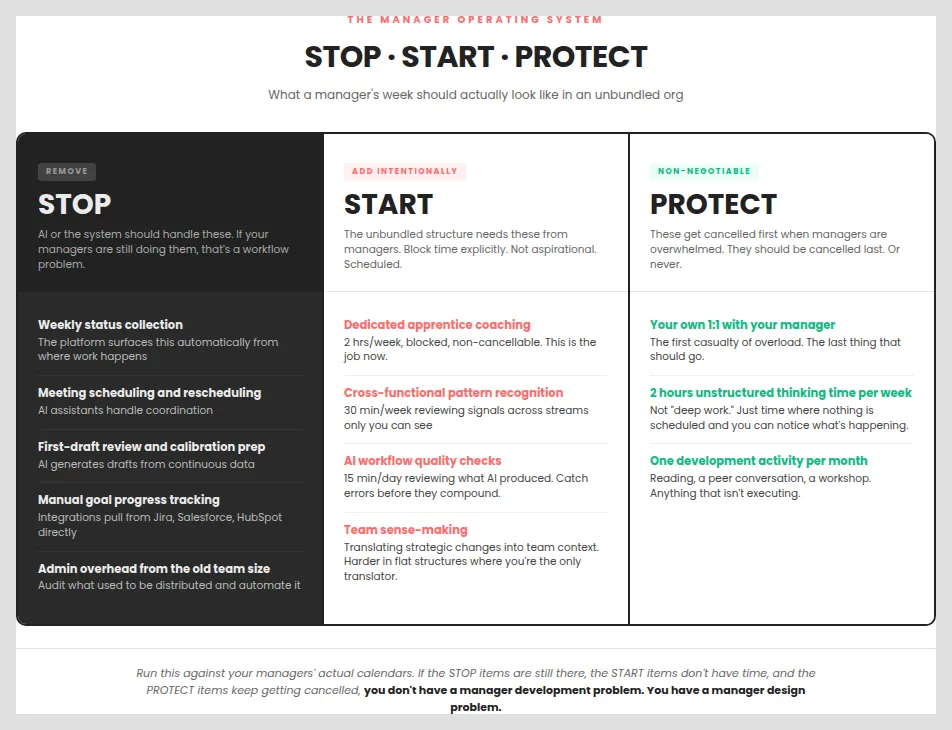
The framework fits on one page. It's not a theoretical exercise. It's a practical diagnostic: look at your manager's calendar and check whether the STOP items are still there, the START items have real time allocated, and the PROTECT items are actually protected. If they're not, you don't have a manager development problem. You have a manager design problem.
__________________________________________________________________________________
I presented the Manager Operating System to Noor on Monday. She read it once, then again.
"Add this to the unbundled org framework as a required companion step," she said. "No function gets redesigned without this being applied to the managers simultaneously. And Kelly, run it on every manager who's already been through the redesign. Retroactively. Before we lose Priya."
I'm running it this week. Priya and I are talking on Thursday. I don't know if it's too late. I hope it's not.
__________________________________________________________________________________
Here's what I want you to take from this.
If you've redesigned your org around AI in the last year, or if you're about to, ask this question: what does your best manager's week actually look like now? Not what it should look like. Not what the framework says it should look like. What it actually looks like, hour by hour, meeting by meeting, demand by demand.
If the answer is "I don't know," that's the problem. Because your best manager knows. And they're deciding right now whether to tell you or tell a recruiter.
The Manager Operating System (STOP / START / PROTECT) is yours. Screenshot it. Use it. Run it against your managers' actual calendars this week. If you find what I found, you'll know what to fix. And you'll know before the Slack alert tells you.

.svg)

.svg)