.svg)

How to Redesign Orgs in the Age of AI
Last week, Kelly and team showed you how you can build 3 HR AI Agents from scratch. This episode is all about the next step. Every CHRO, CEO, and department head we've talked to in the last six months is carrying the same question: what does our org chart actually look like when AI agents can do the work of a team member? And most of them do not have a good answer yet, which is the honest state of organizational design in 2026.
If you are time-strapped and want to skip directly to the white paper, here you go.
This episode is about what happens when Noor forces Kelly to actually answer that question. Not theoretically. For a specific hiring request that's sitting on her desk.
If you're trying to figure out how to redesign your own org, or having the same conversations with your CFO about AI and headcount that every CHRO is having right now, you'll recognize the moment.
__________________________________________________________________________________
Kelly was reviewing a headcount request from the VP of Engineering when Noor walked into her office without knocking.
"I saw the request you're reviewing," Noor said. "I already rejected it."
Kelly blinked. "You haven't seen my recommendation yet."
"I don't need to. The request is wrong."
The request, submitted by Dev Patel (VP Engineering), was for a new team being built around Meridian's next clinical product. Standard structure. One director, two staff engineers, four senior engineers, four mid-level engineers, one junior engineer. Twelve people. Total first-year cost roughly two point four million. Kelly had been planning to recommend approval with minor adjustments to the seniority mix.
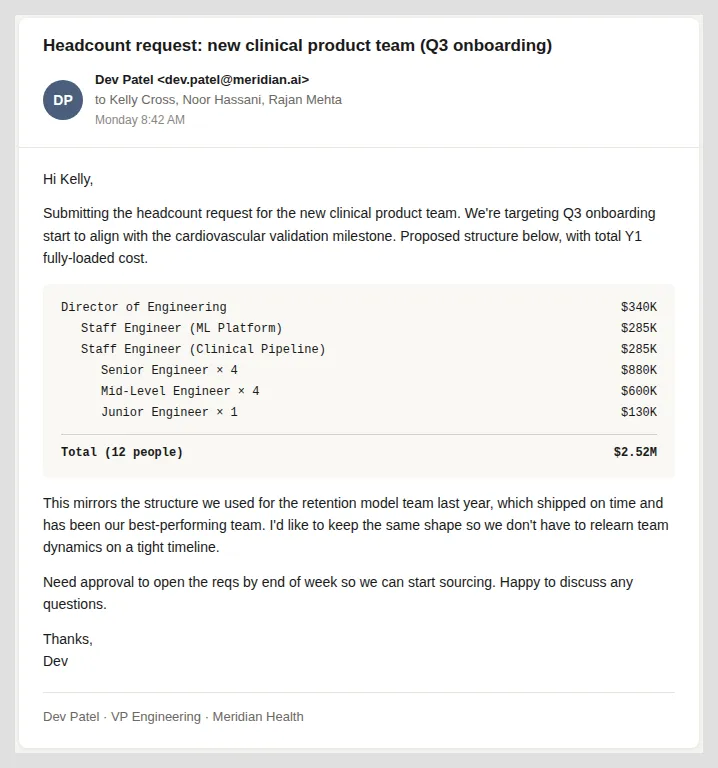
Noor sat down. "Why does this look like a 2019 org chart?"
"Because it's a standard engineering team structure?"
"Exactly. It's what every company was building five years ago when humans were the only way to get work done. We have AI agents doing the work of multiple junior engineers right now. Dev knows this. His existing teams are already operating this way. So why is he requesting a structure that pretends the world has not changed?"
Kelly did not have a good answer, which was the point.
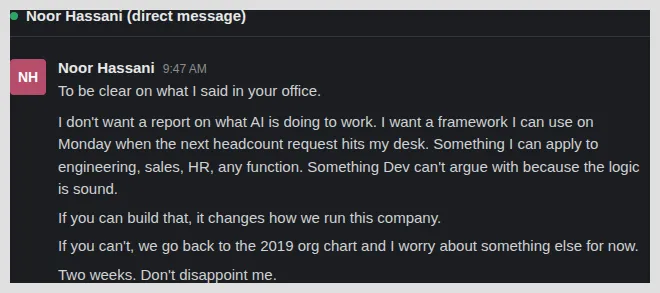
"I'm not approving this request until you come back with a new framework," Noor said. "I want to know how teams at Meridian should be structured given what AI is actually doing to the work. Not theoretical. Actionable. So when Dev submits his next request, I have something to evaluate it against. Two weeks."
She stood up to leave. At the door, she paused.
"Kelly. This isn't just about Dev's team. Once we figure this out for engineering, we apply it everywhere. Including HR."
Kelly looked down at the headcount request. Two weeks to invent a new way to think about how her company builds teams.
This was going to be a long two weeks.
__________________________________________________________________________________
She started with Sena.
Dr. Sena Okafor, Meridian's Chief Science Officer, ran a research team that had already been through its own version of this transformation. Two years ago her team had eight people: three senior researchers, three mid-level researchers, and two research associates doing the literature reviews and data preparation work. Today the team had five people: three senior researchers, one mid-level, and one new role Sena had created that didn't exist before, a research operations lead who maintained the AI workflows the team used for literature synthesis, data analysis, and first-draft writing.
"How did you get to this structure?" Kelly asked.
"Accidentally, mostly. The first thing that happened was that we hired a new senior researcher who was fluent in AI workflows from her previous company. Within three months she was producing work that used to take two research associates. So when one of our RAs left, we didn't backfill. We watched what happened. Nothing broke. We waited six months. Still nothing broke. When the second RA left, we created the research ops role instead of backfilling the RA. The team produces more now than it did with eight people."
"What about the junior pipeline?"
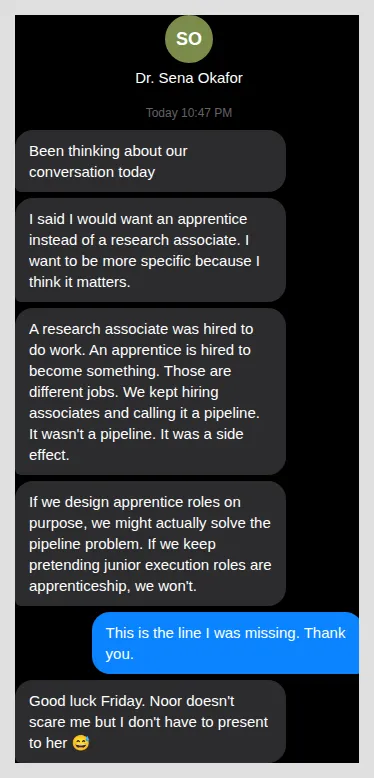
Sena's face changed. "This is the part I'm worried about. The research associate role was how we grew new researchers. Someone joined as an RA, spent three years learning how clinical research actually works, then became a senior researcher themselves. That pipeline is gone. I have five researchers now and in five years when two of them leave, I have no one senior enough to replace them. I haven't solved that. I'm not sure I know how."
Kelly wrote down the sentence in her notebook: the pipeline problem nobody is solving.
"What would you want if you could design your team from scratch tomorrow?"
Sena thought about it. "I would want the same five people, but I would want an apprentice. Not a research associate doing the work the AI now does. An apprentice attached to a senior researcher, whose only job is to learn by watching and then taking on small pieces of real research work under supervision. I wouldn't expect them to produce output. I would expect them to become senior researchers in three years. That's the apprentice role I wish I had designed two years ago instead of discovering this problem now."
Kelly wrote that down too. Apprentice, not junior. Different job entirely.
__________________________________________________________________________________
Next she went to Marcus.
He had been running the numbers on AI-driven org economics for a few weeks already, mostly because he could not help himself. When Kelly explained the Noor assignment, he pulled up a spreadsheet.
"I've been modeling this. There are three different paths a team can take when you bring AI in, and the math is completely different for each one."
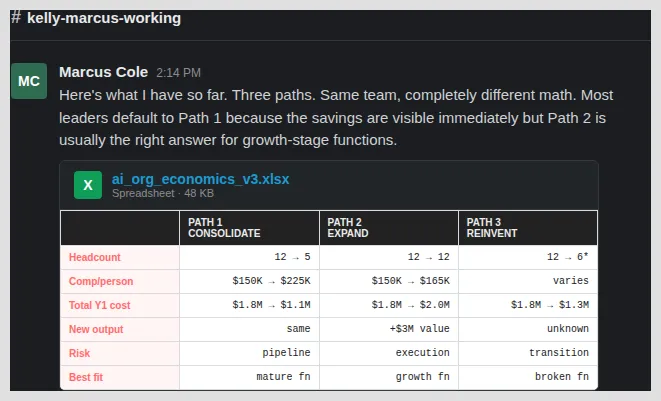
He walked her through it. Path one was consolidation: fewer people, higher comp per person, lower total cost. Path two was expansion: same people, upskilled, generating new capabilities the team couldn't previously build. Path three was reinvention: zero-based rebuild around AI as a core team member. Each path had different inputs, different economics, different risks, and different conditions under which it was the right answer.
"The trap most leaders fall into," Marcus said, "is thinking there's a single right answer. There isn't. Dev's engineering team should probably be on path two. Our own HR function might be on path three. Finance might be on path one. The right answer depends on the function's maturity, the team's latent capability, and what the organization actually needs."
"So the framework isn't one path, it's a way to choose between paths?"
"Correct. And there's a whole other framework for when you're not in a strategic situation at all, when you just need to cut cost because leadership told you to. That's a different analytical tool entirely."
Kelly thought about this. "Can you write up what you have?"
"Already starting. I'll have something for you in a few days."
__________________________________________________________________________________
On Wednesday she had the conversation she had been avoiding.
Rajan Mehta, Meridian's CFO, was the person Kelly was going to need to align with before she could present anything to Noor. If she came back with a framework that made financial sense to her but didn't make sense to Rajan, the whole thing would collapse the first time a team actually tried to implement it.
She explained what Noor had asked her to do. Rajan listened carefully, which was his way, and then asked the question she had been expecting.
"If we bring AI in and a team becomes more productive, can we reduce headcount and capture the savings?"
"Sometimes. Not always. And if we always reduce headcount, we will do real damage to morale, to trust, and to our ability to attract senior talent. There's a version of this where we reduce headcount and reinvest the savings into higher comp for the remaining people. There's another version where we keep the headcount and use the freed capacity to build capabilities we couldn't previously afford. There's a third version where we redesign the function from scratch. And there's a fourth version, when we're under specific cost pressure, where we need a different analytical approach entirely to figure out what to cut without destroying what matters."
"What's the difference between 'strategic latitude' and 'cost pressure'?"
"Strategic latitude is when you have the financial room to choose among paths. Cost pressure is when the board has already told us we need to take out a specific amount of cost and the question is execution, not strategy. We should be honest about which situation we're in. Right now I think we have strategic latitude on most of our functions. But that's going to change at some point, and when it does, we need a framework that doesn't default to across-the-board cuts."
Rajan was quiet for a long time.
"Kelly, this is the most intelligent conversation I've had about AI and headcount in six months. Most of what I'm hearing is either 'AI will save us fifty percent of our people costs' or 'AI is a tool, nothing really changes.' Neither is true. You're saying something more honest and more useful."
"I'm saying we need a framework. I don't have it yet. I have two weeks."
"Tell me how I can help."
"Be ready to tell me I'm wrong when I am. This thing only works if the economics are actually defensible, and you're the person who can pressure test that."
__________________________________________________________________________________
Kelly spent the weekend thinking.
What she kept coming back to was that organizational design conversations were happening at the wrong level. Everyone she talked to was having "how many people do we need" conversations. Dev was having that conversation when he submitted his request. Sena had been having it when she decided not to backfill her research associates. Rajan had been having it when he modeled cost scenarios. Even Kelly herself, when Noor first walked in, had been about to have that conversation.
But "how many people do we need" was not the right question anymore. The right question was something like "which tasks still need humans, what leverage are our senior people not getting, what capabilities could we now build that we couldn't before, and how do we pay for any of it."
Four different questions. Four different angles on the same problem. None of them sufficient on their own, but together they made a framework.
By Sunday evening she had something on paper.
__________________________________________________________________________________
She spent Monday through Thursday testing it. She applied it to Dev's engineering team. She applied it to Sena's research team. She applied it to her own People function. She had Marcus pressure-test the economics. She had Rajan push back on the assumptions. She revised it four times.
By Thursday night she had a framework with four lenses, an honest account of when each lens was strong and when it was weak, a worked example using her own team, and a set of questions that any leader could apply to their own function. Not a prescription. A thinking tool.
Friday morning she walked into Noor's office.
She did not use slides. She brought a single document and walked Noor through it.
When she was done, Noor looked at the document for a long time before speaking.
"Apply this to Dev's request and come back to me Monday with a new recommendation," Noor said. "Then I want you to run this exercise on every open headcount request in the company. This is how we're going to make hiring decisions from now on."
Kelly nodded.
"And Kelly. Write this up. Don't let it live only in our heads. Other leaders are struggling with the same question we were struggling with two weeks ago. Share what we figured out."
__________________________________________________________________________________
The full framework Kelly built is now available as a downloadable paper we're calling The Unbundled Org.
It includes:
Four lenses for thinking about organizational design in the AI era. The Task Lens (what work should humans still be doing, with time-weighting to surface the busyness trap). The Leverage Lens (where is senior judgment being wasted and what would happen if AI freed it up). The Capability Lens (what new functions can you now build that you couldn't afford before). The Economic Lens (three strategic paths plus a cost pressure framework for when latitude disappears).
A worked example applying all four lenses to the HR function. The same exercise can be done for any function. We use HR because that's where our practitioner knowledge is deepest.
The conversations every CHRO should be having with their CEO, CFO, and department heads. The questions that need to be on the table and the shared vocabulary that makes them answerable.
A three-dimensional role analysis framework for cost pressure situations. Compensation, reconstitution cost, and business impact. Most leaders evaluate roles on one dimension and get predictable, damaging results. This framework shows why the other two dimensions matter more than the first one.
It is a thinking tool, not a prescription. It will fire new connections in your head about decisions you have been sitting on. It will give you vocabulary for conversations you are already trying to have. It will not tell you what your org chart should look like, because the honest answer depends on your situation, your function, your stage, and your constraints in ways that no universal document can address.

.svg)

.svg)