.svg)

I Got My HR Team Using AI in One Week. Here's How.
Your CEO has asked you about AI. Maybe not directly. Maybe it was a Slack message, a board question, or a comment in a leadership meeting that sounded casual but wasn't. "What's our AI strategy for the people function?"
Episode 3 is about how Kelly built one. Not a strategy deck. Not a vendor evaluation. A real answer, built in one week, with a team that ranged from enthusiastic to openly skeptical.
If you've been meaning to figure out AI for your HR team but haven't started yet, this episode is your starting point.
__________________________________________________________________________________
Week three at Meridian. Kelly was staring at her whiteboard. Four workstreams. Six people. Eight weeks. The math didn't work.
Noor had asked for a performance architecture, an acquisition integration plan, a hiring infrastructure for scaling to 750, and a trust-building strategy for Caleo's Portland team. Any one of these was a quarter's worth of work. Kelly had all four, simultaneously, with a team that was still figuring out whether they trusted her.
She could push everyone harder. She'd done that before at LumaCore and watched it grind people into dust. She could ask Noor for more headcount. But Noor would ask why she couldn't do more with what she had, and honestly, it was a fair question.
The third option was the one she kept coming back to: change how the team works.
She'd been using Claude herself for the past year. Drafting communications, pressure-testing ideas, building frameworks from scratch in an afternoon instead of a week. It had quietly become the most useful tool in her workflow. She hadn't talked about it much because most people's experience of "AI in HR" was a vendor pitch, not a practical reality.
Time to change that.
__________________________________________________________________________________
She brought it up in the Monday team meeting. No slides. No mandate. Just a question.
"How many of you are using AI in your work right now?"
Marcus raised his hand immediately. "Claude. Every day. Comp modeling, benchmarking analysis, drafting compensation philosophies."
Sofia half-raised hers. "I've tried it for job descriptions. Mixed results."
Jonah shook his head. "I wouldn't know where to start."
Claire said nothing.
Kelly didn't push. "Here's what I want to try. One week. Pick one task that eats your time. Use Claude for it. If it helps, great. If it doesn't, we drop it. No pressure, no judgment, no tracking."
Claire finally spoke. "What about confidentiality? We handle sensitive employee data. I'm not comfortable pasting that into an AI tool."
Kelly had been waiting for this. "Fair concern. Ground rules: no employee names, no compensation data for specific people, no performance review content. Use it for frameworks, drafts, analysis structures, and communication templates. Think of it as a very smart intern who knows nothing about our employees but knows a lot about how HR works."
Claire didn't look convinced. But she didn't push back either.
__________________________________________________________________________________
Kelly started with Sofia because she was drowning.
They sat together that afternoon. Sofia had 14 open roles, three recruiters, and a timeline that assumed she could hire senior ML researchers as easily as account executives. She was spending 45 minutes per personalized outreach message because these candidates got 30 recruiter pings a week and anything generic went straight to trash.
"Show me what you normally write," Kelly said.
Sofia pulled up a draft. It was good. Professional, well-researched, personalized. It also took her 45 minutes because she was reading each candidate's papers, LinkedIn posts, and talks to find the right angle.
"What if Claude did the first 80% and you did the last 20%?" Kelly opened Claude and typed:
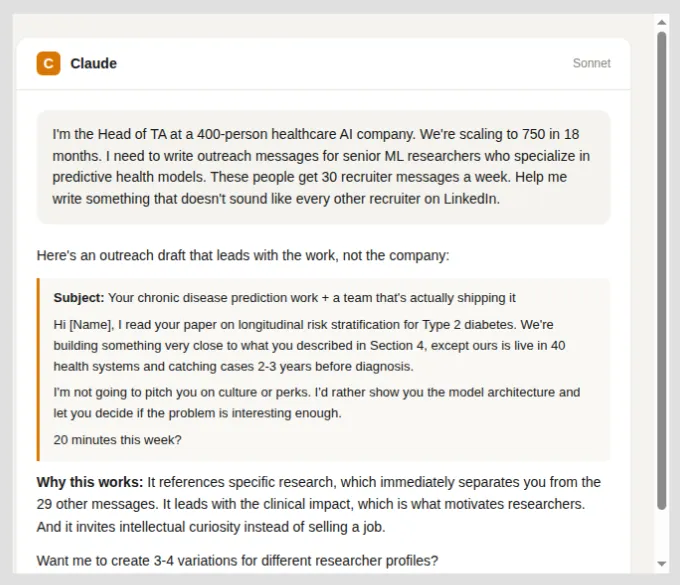
Sofia stared at the screen. "That took thirty seconds."
"Now imagine you spend five minutes refining it with details only you know. That's six messages an hour instead of one."
Sofia was already typing her next prompt.
__________________________________________________________________________________
Marcus didn't need convincing. He'd been using Claude for months. But Kelly asked him to do something different: show the team what he'd built.
In the next team meeting, Marcus walked everyone through his comp analysis workflow. He fed Claude market data from three benchmarking sources alongside Meridian's internal bands and asked it to flag roles where they were more than 15% below market. Then he asked it to draft talking points for each flagged role explaining the gap and recommending adjustments.
"This used to take me two full days," Marcus said. "Now it takes about three hours, and the output is better because I spend my time on judgment calls instead of data assembly."
Jonah looked like someone had turned on a light. "Could I do something similar for skills gaps? Feed it our business objectives and current team capabilities?"
Marcus nodded. "That's exactly how I'd start."
By Wednesday, Jonah had used Claude to build a skills gap framework for Sena's research team. It took him an afternoon. He'd been stuck on this for months. When he shared it with Sena, she called it "surprisingly thoughtful," which from Sena was the equivalent of a five-star review.
__________________________________________________________________________________
By Friday, the results were showing up in the team Slack channel:
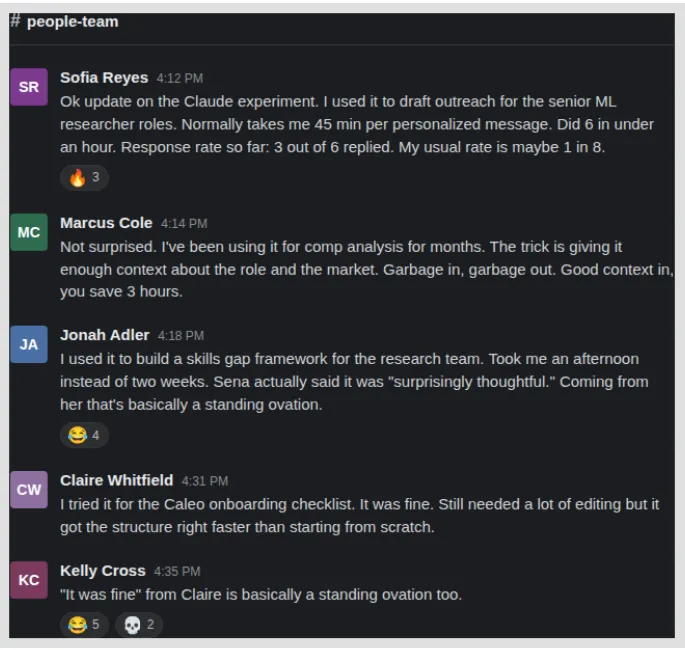
Kelly read the thread three times. Not because of the results, though those were good. Because of Claire's message. "It was fine" was Claire's version of cracking the door open. And the fact that she'd posted it publicly, in the team channel, meant something.
__________________________________________________________________________________
That night, Kelly's phone buzzed. A text from Claire.
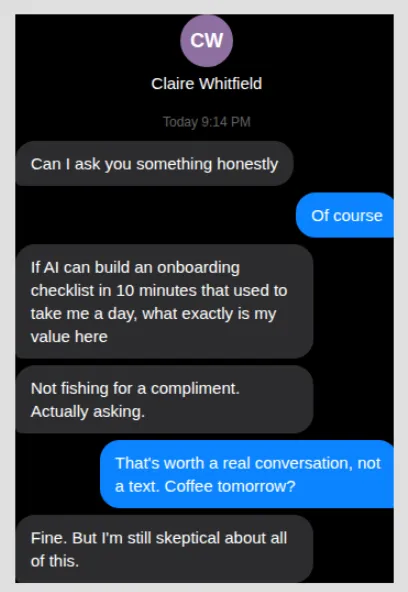
Kelly put her phone down and smiled. Three weeks in and Claire was asking for help. Not about a process or a policy. About how to lead through change. That was a different conversation entirely.
She wasn't going to rush it.
__________________________________________________________________________________
APPENDIX: AI Fluency Starter Kit for HR Teams
If you want to run the same experiment Kelly did, here's how to start. These examples all use Claude (claude.ai), but the principles apply to any AI assistant.
The one-week challenge: Ask each team member to pick one task that eats their time. Use Claude for it for one week. Share results on Friday. No mandate, no tracking.
Ground rules for HR teams: No employee names. No individual comp data. No performance review content. No confidential investigation details. Use AI for frameworks, drafts, and analysis structures, not for decisions about people.
Starter prompts by HR function:
Talent Acquisition: "I'm hiring for [role] at a [size] [industry] company. The ideal candidate has [key qualifications]. Write a personalized outreach message that leads with the work and the mission, not perks or culture. Make it sound like a human wrote it, not a recruiter template."
Total Rewards: "Here is anonymized market data for [role type] across [3-4 benchmarking sources]. Compare these to our internal band of [range]. Flag where we're more than 15% below market and draft a one-paragraph justification for each adjustment."
Learning & Development: "Our company's top 3 business priorities for the next 12 months are [list them]. Based on these priorities, what skills should we be developing across [specific teams]? Create a skills gap framework with recommended development approaches for each gap."
People Operations: "We're integrating a 60-person acquired company into our 400-person organization. Draft an onboarding checklist for acquired employees that covers first week logistics, system access, cultural orientation, and manager introductions. Assume the acquired team has been through a rough period and may be skeptical."
Communications: "Draft an internal announcement about [change]. The audience is [who]. The tone should be [direct/empathetic/energizing]. Include: what's changing, why, what it means for them, and what happens next. Keep it under 200 words."
How to get better results from Claude:
Give it your role, your company context, and your audience. The more specific your input, the better the output. "Write a job description" gets generic results. "Write a job description for a senior ML researcher at a healthcare AI company that leads with clinical impact and mentions our work in predictive chronic disease models" gets something you can actually use.
Tell Claude what not to do. "Don't use corporate jargon. Don't make it longer than 150 words. Don't include buzzwords like 'synergy' or 'leverage.'" Constraints produce better output.
Iterate. The first output is a draft, not a final product. Push back: "This is too formal. Make it sound like a person, not a press release." or "Good structure but the tone is wrong. Make it more direct and less optimistic."
What AI can't do (and you shouldn't ask it to):
Make people decisions. AI can surface data and draft recommendations. The judgment call is yours.
Replace relationships. No prompt will build trust with a skeptical team or navigate a sensitive conversation.
Guarantee accuracy. Always review outputs for your specific context. AI doesn't know your company culture, your politics, or the thing that happened last quarter that everyone's still upset about.
__________________________________________________________________________________
Dear Kelly: Have you started using AI in your HR team? What worked? What flopped? What are you still figuring out? Drop your story here.

.svg)

.svg)