.svg)

Your Direct Report Wants Your Job
.webp)
Every CPO who's started somewhere new knows the first team meeting is an audition you didn't ask for. Your new team is sizing you up before you've finished your opening sentence. And at least one person in the room is wondering why it wasn't them.
Episode 2 is about that room. And what you should do when you meet your new team.
------------------------------------------------------------------------------------------------------------
Kelly's HR team at Meridian was six people. She'd studied their profiles, read their work, and formed early impressions. But two people stood out before she'd even walked into the room.
Marcus Cole, Head of Total Rewards. Joined from a Big 4 HR consulting practice two years ago because he wanted to build things instead of advise on them. Analytical, AI-forward, already running comp models nobody had asked for. He'd responded to Kelly's intro email in seven minutes.
Claire Whitfield, Head of People Operations. Three years at Meridian. Aarav's number two. She knew every employee, every policy, every unwritten rule. The team treated her as the person who actually ran things. She had expected the CPO job. She did not get it.
The rest of the team rounded out the function: Sofia Reyes leading Talent Acquisition, Jonah Adler in L&D still figuring out a mandate Aarav never defined, and two HRBPs covering Engineering/Research and Go-to-Market.
------------------------------------------------------------------------------------------------------------
First team meeting. 9 am. Kelly arrived to find everyone seated. Claire was in the chair closest to the whiteboard, the one the most senior person in the room takes by default.
Kelly sat at the head of the table.
"I want to hear from each of you. What's working, what's broken, and what's the one thing you wish your last leader had done differently."
Marcus went first. "We're making comp decisions on instinct. I've built models that benchmark us against market and internal equity but nobody's ever used them. I wish data had a seat at the table."
"It will," Kelly said. Two words. She'd earned his attention.
Claire went last.
"What's working is the culture. People trust this team because we've been consistent. What I'd change is..." she paused, "I'd make sure whatever gets built next doesn't break what already works."
That was aimed at Kelly. Politely, but precisely.
------------------------------------------------------------------------------------------------------------
The first undermining happened an hour later. Jonah stopped by Kelly's office to ask about his L&D mandate. Before Kelly could respond, Claire appeared at the door. "Jonah, we talked about this. The approach is to align L&D with the priorities Noor set in the all-hands. I can send you the notes."
Jonah looked at Kelly, then Claire, then back at Kelly. He was clearly confused who to take orders from.
"Thanks, Claire," Kelly said. "Jonah, let's set up time this week and I'll work through it with you directly."
The second was subtler. Kelly had asked the team for a current state summary. Within thirty minutes, Claire replied. She had marked the entire HR team and put Noor in cc.
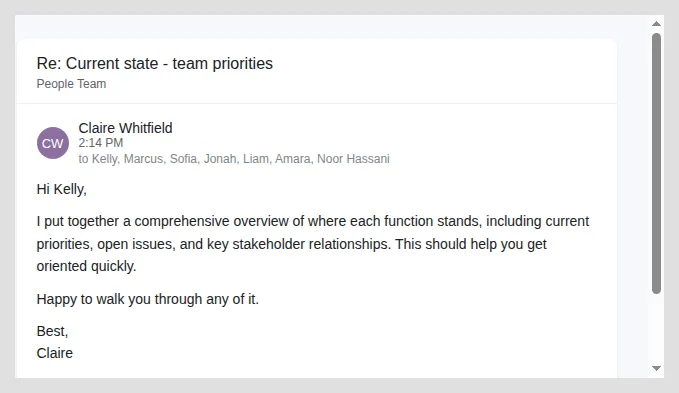
Claire was showing the team and Noor that she already had everything, and that Kelly was the one playing catch-up. Also, she knew that Kelly could not call her out for putting Noor in cc without looking petty.
The third was the most pointed. Liam Kearney, the HRBP covering Engineering and Research, mentioned he was prepping for a meeting with Sena's research leads. Claire interjected: "Liam, loop me in. Sena's team is used to working with me. We don't want to overwhelm them with new faces."
Kelly looked up. "Claire, can I grab you for a minute?"
------------------------------------------------------------------------------------------------------------
Small room off the main floor. Door closed. Neither sat down.
"I want to be straight with you," Kelly said. "You jumped in before I could answer Jonah's question. You sent the team a current state doc framed as something I needed for reference. And you just told Liam to loop you in on Sena's team because they're used to you. Each one on its own is reasonable. Together, they send a message. I think you know what that message is."
Claire's jaw tightened. "I've been here three years. I held this team together through Aarav leaving. And I found out I wasn't getting the CPO role from a calendar invite for my interview with you."
Kelly felt that. "That's a terrible way to find out. I mean that."
"It was."
"I can't undo it. But I need you to hear two things. I didn't take this job to sideline you. And if we spend the next six months in a quiet power struggle, the only people who lose are the 400 people who depend on this team."
"I hear you," Claire said. "But hearing and feeling are different things."
"I know. I'm not asking you to feel okay about this. I'm asking you to work with me."
Claire left the room exactly as guarded as she'd walked in. Kelly stood there knowing she'd handled it as well as she could, and also knowing it hadn't changed anything yet.
------------------------------------------------------------------------------------------------------------
Kelly found Noor at 5:30. "Why did you hire externally when Claire was here?"
"Because Claire is excellent at maintaining what exists. She's trusted, consistent, knows this company better than anyone. But she doesn't know how to build what we need next."
"Did you tell her specifically what the gap was?"
Noor paused. "No. I didn't want to make her feel like I was cataloguing her weaknesses."
"So she's been left to write her own story about why she wasn't picked. And the story she's written is worse than the truth."
Noor considered this. "That's fair. I got that wrong."
Kelly hadn't expected Noor to concede that fast. Daniel would have argued for twenty minutes.
"Do you want me to have that conversation with her?" Noor asked.
"Not yet. Let me build some trust first. If it comes from you now, it'll feel like piling on."
------------------------------------------------------------------------------------------------------------
Kelly drove home replaying the day. Claire's face. Marcus's quiet energy. The careful neutrality of everyone else waiting to see which way things would go.
Her phone buzzed at 7:48.
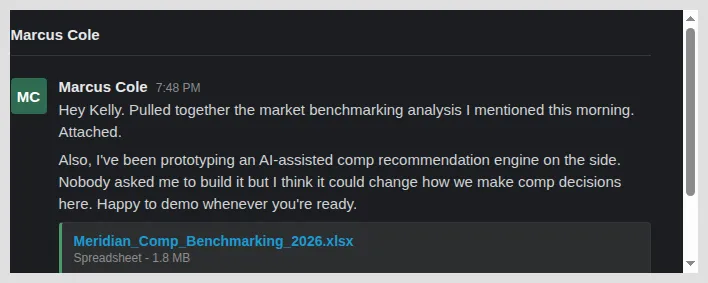
Kelly read it twice. This was someone who'd been waiting for permission to do his best work.
She typed back: "Tomorrow. First thing."
------------------------------------------------------------------------------------------------------------
Inheriting a team? The org chart tells you the structure. The first meeting tells you the culture. But the real map is in the moments between: who answers questions that weren't directed at them, who defers, who's been waiting for someone to unlock them, and who's still grieving the leader you replaced.
Here's what to do in the first 48 hours:
Have a one-on-one with every direct report before you change anything. Ask each person the same three questions: what's working, what's broken, and what did your last leader get wrong? The patterns across answers will tell you more than any handover doc.
Identify who was passed over for your role. There's almost always someone. Don't avoid it. Address it directly and early. Name the awkwardness. You won't resolve it in one conversation but you'll earn respect for not pretending it doesn't exist.
Watch who the team defers to informally. That person holds more influence than the org chart suggests. They're either your biggest ally or your biggest obstacle. Figure out which one fast.
Don't over-correct on day one. The instinct is to prove you belong by making changes quickly. Resist it. Your first job is to understand the system before you touch it.
Dear Kelly: Have you been the external hire who walked into a team where someone wanted your job? Or the internal person who got passed over? Kelly wants to hear both sides. Drop your story here.
Until next time... deep breaths, strong coffee, and better systems.
-Kelly, your HR best friend at Klaar

.svg)

.svg)