.svg)

3 HR Agents You Can Build This Week
Last week's episode was about getting your HR team started with AI. This week is for the people who are already past that stage. You've been using Claude for a while. Your team has favorite prompts. You've even touched Projects and MCPs. And now you're wondering what comes next.
What comes next is agents.
Not the scary sci-fi version. The practical kind: a single workflow that strings together 5 or 6 steps a human would normally do one at a time, pulls from the tools where your data already lives, and gives you back something you can ship in minutes instead of hours.
Episode 4 walks through three agentic workflows Kelly's team built at Meridian in a single week. Each one is real, replicable, and gated behind a simple truth that becomes unavoidable by the end of the episode.
__________________________________________________________________________________
Kelly's team had a problem.
Three weeks into their AI experiment, everyone was using Claude in their own way. Marcus had his comp workflows. Sofia had her recruiting prompts. Jonah had his skills gap frameworks. All of it was working, which was the problem. None of it was shared. Sofia was out sick one day and Marcus had to recreate her entire outreach flow from scratch.
"We don't have a team workflow," Marcus said. "We have six people running six parallel experiments."
Kelly saw it the same way. They needed to move from "using AI" to "building agents." Shared workflows, with real instructions, connected to real tools, that anyone on the team could run. So they picked three use cases and spent a week building them out.
Here's what they built.
__________________________________________________________________________________
Workflow 1: The Hiring Agent
Sofia's problem was volume. She had 14 open roles and three recruiters. Every role needed a job description, a sourcing strategy, outreach templates, interview questions, and a scoring rubric. That was 70+ deliverables before a single candidate walked in the door.
She built an agent in a Claude Project that handled all of it.
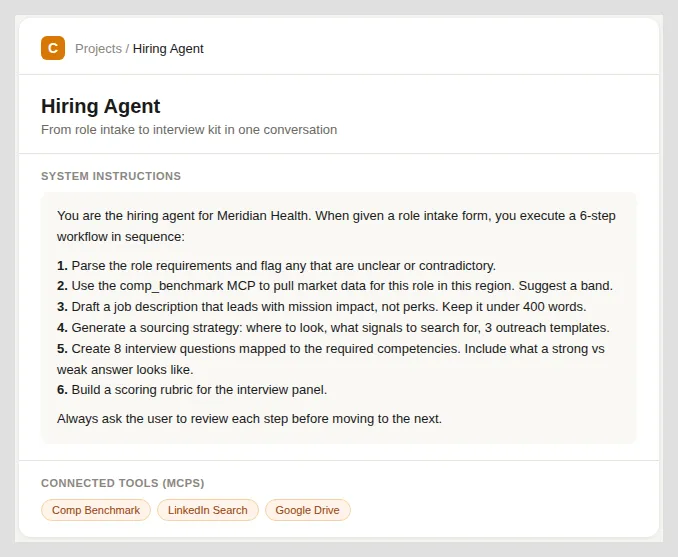
The magic wasn't in any single step. It was that the agent ran them in sequence, carrying context from one step to the next. The job description knew about the comp band. The sourcing strategy knew about the job description. The interview questions knew about both. Sofia went from spending 4 hours per role to spending 40 minutes reviewing and refining what the agent produced.
Where it lives: The outputs land in Google Drive for the recruiting team. The intake form that kicks off the workflow is a shared team doc. The comp data comes from a benchmarking MCP. Everything the agent touches has a home outside Claude.
__________________________________________________________________________________
Workflow 2: The Acquisition Onboarding Agent
Claire built this one, which surprised everybody including Claire.
The Caleo acquisition meant onboarding 60 people in six weeks. Claire was the only person with the institutional knowledge to design a great onboarding experience, but she couldn't manually write 60 personalized 30/60/90 plans. Until three weeks ago, she would have made a generic template and apologized for it. Instead, she built an agent that took each new hire's profile and generated a personalized package: a 30/60/90 plan tailored to the role, a draft intro message from their new manager, a buddy pairing recommendation with reasoning, and a first-week calendar.
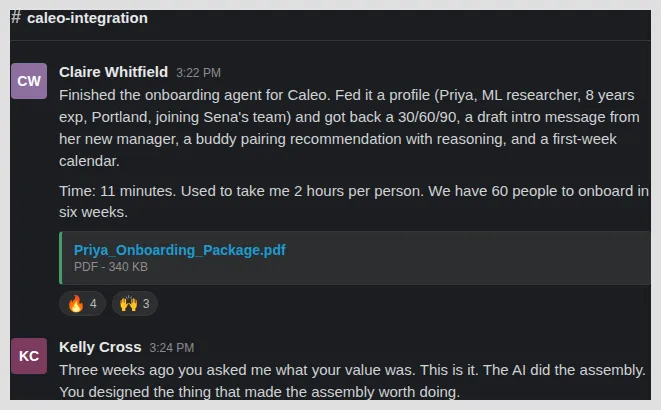
Claire's insight was the most important one of the week: the AI was doing the assembly. Claire was doing the design. Her job wasn't being replaced. It was being amplified.
Where it lives: The profiles come from the HRIS. The generated 30/60/90 lands in the new hire's employee record. The calendar syncs to Google Calendar. The manager intro goes into a draft email. The agent produces outputs. Something else has to house them.
__________________________________________________________________________________
Workflow 3: The Manager Coaching Agent
Jonah took the hardest one.
Every manager at Meridian had recurring 1:1s. Most of them walked in underprepared because they were too busy to review notes, pull up goal data, and think about what to focus on. Jonah wanted to build an agent that would prep the manager automatically: pull the last few 1:1 notes, cross-reference with current goal progress, flag any signals worth discussing, and draft an opener.
He could build the agent in Claude. He could even connect it to Google Drive for 1:1 notes and to their goal tracker. What he couldn't do was make it show up in the manager's Slack 30 minutes before every 1:1, without the manager having to ask.
That's the part that mattered. Managers weren't going to open Claude and run a workflow before every 1:1. They needed the insight to come to them, proactively, in the place where they already work.
Jonah's first version: a Zapier automation that triggered before each 1:1, called Claude with the right context, and pasted the result into Slack. It worked. Barely. The context was incomplete because Claude couldn't see goal progress data in real time. It could only see what had been manually uploaded.
That's when Kelly showed him what Meridian's performance platform already surfaced, automatically, without any agent at all:
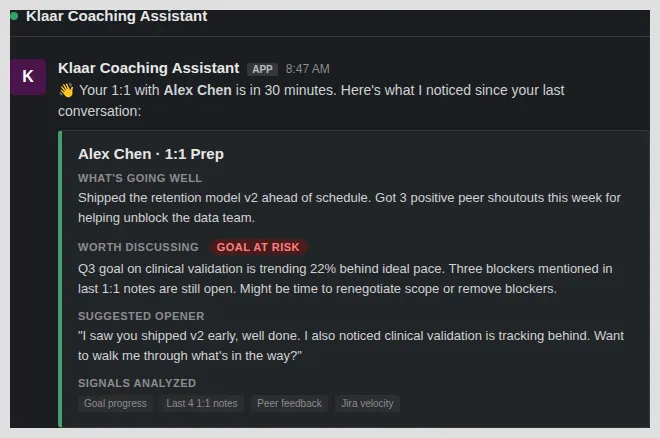
The difference wasn't subtle. The platform had continuous access to goal data, peer feedback, Jira velocity, and 1:1 history. It didn't need to be "called." It was already watching. It already knew Alex's Q3 goal was at risk because it had been tracking the delta between ideal progress and actual progress for weeks. Jonah's Claude agent, by contrast, could only tell you what you fed it in the current conversation.
Both tools were doing the same job. One was an agent built on top of a platform. The other was an agent that had to be the platform, and couldn't.
__________________________________________________________________________________
The pattern that showed up in all three workflows.
Marcus noticed it first. "Every agent we built needs somewhere for the output to live. The hiring agent's outputs go into the ATS. The onboarding agent's outputs go into the HRIS. The coaching agent needs data from the performance platform and pushes insights back into Slack."
Kelly nodded. "The agent is the worker. The platform is the workplace. You can't have one without the other. And if the platform was built 10 years ago with a chatbot bolted on last quarter, the worker is going to be constantly fighting the workplace. If the platform was built assuming AI would be doing half the work, they work together."
That's the distinction that matters in 2026. Not "AI vs SaaS." Built-on-AI vs bolted-on-AI. Purpose-built vs retrofitted. Platforms that assume a continuous intelligence layer vs platforms that treat AI as a feature toggle.
Marcus summed it up at the end of the week: "Agents are incredibly powerful. But agents need a home. And the home matters as much as the agent."
__________________________________________________________________________________
Want the full technical build?
We packaged all three agent workflows into a downloadable library. Each one includes:
The complete Claude Project system instructions. The MCP configurations. The starter prompts that trigger the workflow. Example inputs and outputs. And the specific places where we hit limits and had to either work around them or build the capability into a purpose-built platform.
If you want to build these this week, this is everything you need.
Get it all here.

.svg)

.svg)