.svg)

Season Finale: Thank You, Kelly
This is the Season 1 finale of Behind HR Lines. Unlike other episodes, this episode is told entirely from the perspectives of the people Kelly worked with, fought with, and carried.
For 13 episodes, you've watched Kelly Cross hold LumaCore together. She contained the RTO chaos. She survived calibration politics. She navigated investigations, rumors, retention crises, board meetings, AI mandates, pay transparency blowups, and a burnout wave she spotted before the data did. Last week, she sent her resignation.
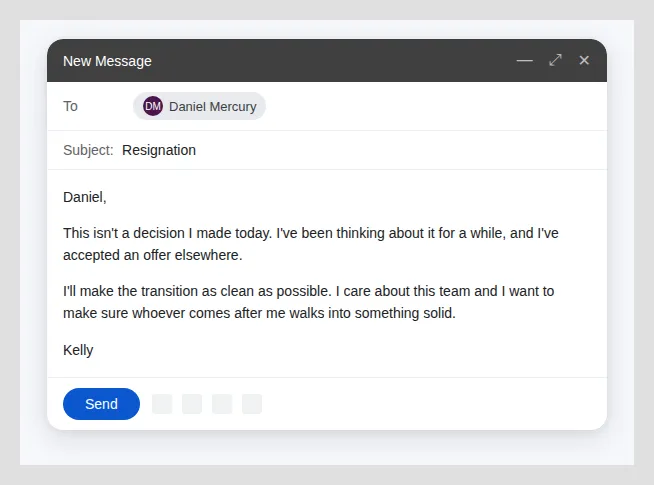
This week, you hear from everyone except Kelly.
Because the hardest thing about losing the person who holds everything together isn't what they say on the way out. It's what everyone else says when they realize she's actually going.
TL;DR
If you don't have time to read the full episode, here's what happens.
Daniel tries to retain Kelly. So does Lena. So does the board. They all fail. Not because the offer isn't good enough, but because the things that pushed her out can't be fixed in a retention conversation. The episode is told entirely from the perspectives of the people Kelly worked with, fought with, and carried. Each one sees the loss differently. And together, they paint a picture of what happens to an organization when the person nobody thanked decides to stop showing up.
DANIEL
He saw the email at 9:14 pm and his first reaction, if he was being honest with himself, was irritation.
Not sadness. Not panic. Irritation. The same feeling he got when a vendor missed a deadline or when someone brought a problem to him without a solution. Kelly was creating a problem. That was his first thought, and later he would not be proud of it.
He called her the next morning. She picked up on the second ring, which meant she'd been expecting it. "Kelly, let's not do this," he said. "Tell me what you need."
"I appreciate that, Daniel. But I've already accepted."
"Accepted what? Where?"
"Somewhere I think I can build something from earlier in the curve."
He didn't like how calm she sounded. When people were emotional about leaving, you could work with that. When they were calm, the decision was already behind them.
"What if we restructured your role? More board exposure, direct report to me with no filter. I'll make it official."
Kelly was quiet for a second. "You're offering me things that should have already been true."
That one sat with him longer than he expected.
He tried again over the next two days. He had Lena talk to her. He floated a comp increase that Lena told him was aggressive but defensible. He mentioned equity. He even said, in a moment of uncharacteristic vulnerability, "I don't think you understand how much this place depends on you."
Kelly's response was kind. And final. "Daniel, I know you mean that. But you're saying it because I'm leaving. If I stayed, things would go back to how they were within a month. You know that."
He wanted to argue. He wanted to say she was being unfair. But somewhere underneath the irritation, in a place he didn't visit often, he knew she was right. He'd spent a year treating her like infrastructure. Reliable, invisible, and only noticed when something broke.
The board member who'd grilled him about talent risks called that afternoon. "I heard Kelly Cross is leaving. What happened?"
Daniel said, "She got a better offer."
There was a pause on the line. "That's not why people like her leave, Daniel."
He didn't have a good answer for that.
LENA
Lena found out before the email. Kelly had called her the night before, which is how Lena knew it was real. Kelly didn't call people at home unless it mattered.
"I wanted you to hear it from me," Kelly said.
Lena sat on her kitchen counter and listened. She didn't try to talk her out of it. She'd watched Kelly absorb too much for too long and she'd watched the company take that for granted. Lena was a numbers person and even she could see that the math on Kelly's situation hadn't added up for a while.
"Are you okay?" Lena asked.
"I think so. I will be."
"You know everyone's going to panic."
Kelly laughed. "For about a week. Then they'll post the job and move on."
"I won't move on that fast," Lena said, and meant it.
They'd built a real working relationship. Not the performative kind you describe in leadership offsites. The kind where you can call someone and say "this is broken" without wrapping it in three layers of diplomacy. Lena had worked with four CPOs before Kelly. None of them made her feel like they were solving the same problem from different angles. Kelly did.
During the retention push, Lena did her part. She put together a comp package that she genuinely thought was fair. She presented it to Kelly over coffee, no pressure, no theatrics.
Kelly looked at the numbers. "This is generous, Lena. Really."
"But?"
"But I'm not leaving because of money. I'm leaving because of what the money is trying to fix."
Lena nodded. She already knew. She just wanted Kelly to know that someone had tried honestly, not as a corporate exercise, but because she actually wanted her to stay.
After Kelly left the coffee shop, Lena sat there for a few more minutes. She thought about all the times Kelly had walked into a room full of people who didn't understand what she did and made them better at their jobs anyway. She thought about the fact that in twelve months of working closely together, not once had anyone in leadership asked Kelly what she needed.
The appreciation only shows up when someone's halfway out the door. Lena knew that was true across every company she'd ever worked at. She'd just never felt it this personally before.
JESSICA
Jessica heard through Slack. Someone in Sales mentioned it casually, the way people mention earthquakes they didn't feel. "Heads up, Kelly's leaving."
Her first thought surprised her. It wasn't good riddance. It wasn't political calculation. It was something closer to: well, that's a loss.
She'd never admit that in a meeting. Her relationship with Kelly had been adversarial for most of the year. Calibration. The investigation. The counteroffer policy. Jessica had pushed, and Kelly had pushed back, and neither of them had blinked.
But here was the thing Jessica understood about Kelly that most people didn't: Kelly pushed back because she was right. Not always. But often enough that Jessica had learned to check her own assumptions before walking into a room where Kelly would be.
That's a rare thing to lose. Most HR leaders Jessica had worked with either folded under pressure or hid behind process. Kelly did neither. She stood in the middle and said what was true, even when it made the room uncomfortable.
Jessica walked past Kelly's office that afternoon. The door was open. Kelly was packing a box, the slow kind of packing where you're deciding what actually matters enough to take with you.
Jessica leaned against the doorframe. "For what it's worth," she said, "you made me better at my job. I didn't enjoy it. But you did."
Kelly looked up and smiled. "That might be the nicest thing you've ever said to me."
"Don't get used to it."
They both laughed. It was the easiest conversation they'd ever had, and it was the last one.
PARKER
Parker sent a Slack message. Of course he did.
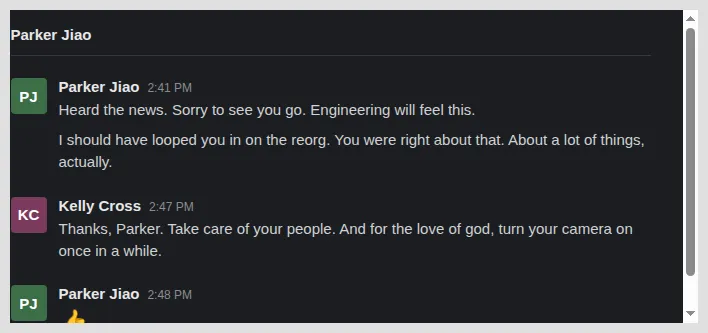
Maya, who was sitting near Kelly when the message came through, said, "That's the most Parker has communicated in a single day all year."
SAMIR
Samir called Kelly on her personal phone, which he had never done before.
"I'm not going to try to talk you out of this," he said. "I'm a lawyer. I know when the case is closed."
Kelly appreciated that more than he probably realized.
"I just want to say one thing," he continued. "You made Legal's job easier every single time. You documented. You followed process. You never made us clean up after a shortcut. Do you know how rare that is?"
"I'm going to pretend you're not complimenting me by saying I created less legal liability than average."
"Take the compliment, Kelly."
She did.
MAYA
Maya didn't find out through an email or a Slack message. She knew the moment she walked into Kelly's office on Tuesday morning and saw the look on her face.
"You sent it," Maya said.
"Last night."
Maya sat down slowly. She'd prepared herself for this. She'd watched Kelly's energy shift over the past few months, watched her absorb one more thing and then one more thing after that, watched the cumulative weight of being the person everyone depended on and nobody thanked.
She'd even told herself she'd be fine when it happened. She wasn't fine.
"What happens now?" Maya asked. She meant to the team, to the function, to all the systems and relationships Kelly had built. But she also meant to herself.
Kelly read both questions. "The team is strong. You're strong. The systems work. Whoever comes in next will inherit something real, not a house of cards."
"And if they don't get it? If they undo things?"
Kelly paused. "Then you protect what matters. And you'll know what matters because you helped build it."
Maya nodded. There was a lump in her throat she was actively ignoring.
Over the next two weeks, they did the transition together. Kelly was methodical about it. Every process documented. Every relationship mapped. Every landmine flagged. She treated her exit the way she treated every crisis: with structure and care, even when nobody was watching.
On Kelly's last Friday, Maya stopped by her office one final time. Most of Kelly's things were already gone. Just her laptop, her notebook, and the mug that said "I survived another meeting that should have been an email."
"I need you to know something," Maya said. "You changed how I think about this work. Not the frameworks or the processes. The way you treated people when nobody important was in the room. That's what I'm taking with me."
Kelly stood up and hugged her. No words. No advice. Just a hug.
Maya held it together until she got to her car.
Later that evening, Maya sat in her apartment replaying the past year. She thought about what Kelly had said about the team being strong, about the systems working, about protecting what matters. She believed all of that.
But she also thought about something else. Something she hadn't said out loud because the timing felt wrong.
Kelly was going to Meridian Health. She was going to build something new, from earlier in the curve, with a CEO who actually understood what a CPO does. And when that team started growing, when she needed someone she trusted completely, someone who knew how she thought and what she valued and how to protect the work...
Maya wasn't going anywhere. Not yet. But she wasn't closing any doors either.
KELLY
Her last day was quieter than she expected. No big send-off. No awkward cake. Just a series of short conversations with people who waited until the end to say what they should have said all year.
That was the part that stung the most. Not the leaving. The realization that everyone knew her value. They'd always known. They just never thought they had to say it out loud until she forced their hand by walking away.
She thought about that on the drive home. How many organizations are full of people who are seen clearly only in their absence. How the thank-you that comes during a retention conversation is the same thank-you that could have come on any random Tuesday, and would have cost nothing, and might have changed everything.
Kelly got home, dropped her bag by the door, and sat on the couch.
For a few minutes, she just sat there.
Then the unease crept in. The kind that comes when you've just made a decision you believe in but haven't lived yet. At LumaCore, she knew every hallway, every personality, every unwritten rule. She knew when Daniel was about to do something reckless. She knew how to get Lena on her side. She knew that Parker communicated through silence and that Jessica respected you more when you pushed back.
At Meridian, she'd have none of that. New CEO, new team, new politics. She'd have to earn credibility from zero with people who didn't know her yet, who hadn't seen her hold a company together through a year of chaos. She'd have to figure out which battles mattered, which relationships were real, and which smiles hid knives. All over again.
She'd done it before. She could do it again. She just wished, for once, that being good at your job carried over like frequent flyer miles.
Kelly picked up her phone and scrolled to the Meridian onboarding email she'd received that afternoon. Start date: Monday.
She read it twice. Then she set her phone down, leaned back, and let herself feel something she hadn't felt in a long time.
Not dread. Not exhaustion. Not the low hum of being needed by people who didn't notice her.
Curiosity.
She was looking forward to Monday.
That's a wrap on Season 1 of Behind HR Lines.
Kelly's story isn't over. It's just starting somewhere new. Season 2 is coming, and if you thought LumaCore was messy, wait until you see what a "good" company looks like from the inside.
Until next time... deep breaths, strong coffee, and better systems.
- Kelly, your HR best friend at Klaar

.svg)

.svg)