.svg)


68% of Employees Think They're Underpaid. Most of Them Aren't.



Overview
A striking majority of employees believe their pay is unfair, even when the numbers say otherwise. The problem isn't compensation levels. It's that pay decisions are disconnected from the performance signals that should explain them.
This blog explores what's really driving the trust gap in compensation, and what it looks like when performance and pay finally work together.
According to Payscale, 68% of employees believe they're underpaid, even when their compensation is at or above fair market rates. And employees who feel underpaid are 45% more likely to look for a new job, regardless of their actual pay.
Most organizations respond by looking at the numbers. They benchmark salaries. They run pay equity audits. They adjust ranges.
And the perception problem doesn't move.
But when you look closely at how compensation decisions actually get made across organizations—the way we do at Klaar—a different pattern emerges.
The problem isn't what employees are being paid.
It's that the decisions behind the pay can't be explained.
And that distinction matters. Because when performance data and compensation planning live in separate systems, trust erodes…even when the numbers are right.
In this month's blog, we'll explore what's actually driving the compensation trust gap: from the data disconnects and recency bias shaping pay outcomes to the invisible inequity that compounds over time. We'll also look at what forward-thinking organizations are doing differently to close that gap.
Pay Decisions Are Made at the End of the Cycle, Based on the Beginning
Here's the problem no one talks about in compensation planning: by the time leaders sit down to make pay decisions, the performance cycle is effectively over.
Every decision is retrospective. Managers are asked to evaluate months of contribution, synthesize it into a number, and defend it in a room full of peers, often without access to a single real-time performance signal.
What they have instead is recall.
And recall has patterns.
In our calibration data, employees with a visible win in the final six weeks of the cycle were 22% more likely to receive a top rating, regardless of how they performed earlier in the year. The same dynamic plays out in compensation. Late-cycle visibility inflates perceived performance. Quiet consistency gets compressed into the middle.
Most organizations treat this as a process problem…more structure, better timelines, clearer guidelines. But structure doesn't fix the signal.
If the data feeding a pay decision is incomplete, the decision will be too. And if the decision can't be explained, it won't be trusted even if it's correct.
This is where the 68% begins.
When Pay Can't Be Explained, It Won't Be Believed
When organizations try to improve compensation planning, they usually start with the workflow:
- Better templates
- Approval routing
- Centralized trackers
- A dedicated compensation tool
But most compensation tools are built to manage the process, not improve the decision. They make it faster to move through a cycle. They don't make it easier to know whether the right people are being rewarded.
That's because the core issue isn't the spreadsheet. It's that performance data and compensation planning have never been connected.
A manager opens the compensation module. They're asked to enter a merit increase for each direct report. They have no view into that person's goal progress, recent feedback, how their rating was calibrated, or how their contribution compares to peers in similar roles. They're working from whatever they remember or whatever was written in a review months ago.
That's not a process failure, it's a data failure.
And when managers can't explain their decisions, employees fill the gap with their own conclusions. Usually, that they are underpaid.
Unexplained Pay Creates Inequity That Compounds
The consequences of this disconnection don't always show up immediately. They surface later…in attrition numbers, in engagement scores, in exit interviews.
But they're already visible in the pay decisions themselves.
When compensation is made from memory, visibility bias shapes outcomes the same way it shapes ratings. Employees in cross-functional or high-exposure roles are easier to recall as top performers. Consistent contributors whose work is less visible are harder to differentiate at the moment of decision.
Manager variance compounds this further. In our calibration data, two managers leading comparable teams produced rating distributions of 35% and 8% "exceeds expectations" respectively…before calibration. That same variance, unchecked, flows directly into pay recommendations.
The result is the kind of inequity that doesn't show up in audits. It shows up in conversations: when a high performer realizes their raise didn't reflect a year of consistent delivery. When a manager can't explain why an increase was set at a particular number. When trust quietly erodes…not because the decision was wrong, but because it couldn't be defended.
Not unfair pay. Unexplainable pay.
What This Means for Leaders
For leaders, that means the question is no longer just: did we complete the cycle on time? It's: did we make the right decisions for the right people, and can we show our work?
Organizations seeing the strongest outcomes are connecting compensation to the performance data that should drive it—continuously, not just at cycle end, but by:
- Making performance progress visible throughout the year, so compensation conversations are grounded in evidence rather than memory.
- Connecting ratings, calibration outcomes, and feedback directly to pay planning, so managers aren't reconciling two separate systems.
- Creating audit trails that make decisions defensible…not just to leadership, but to the employees those decisions affect.
When these elements are in place, compensation planning shifts from a stressful end-of-cycle scramble to a natural extension of how performance has been tracked all year.
And when employees can see the logic behind their pay, when the decision is grounded in evidence they've been part of all year, the 68% starts to move.
Wrapping Up
Most organizations know their compensation process could be better.
But the fix isn't in how teams are running compensation cycles. It's in the connection between performance data and pay decisions…a connection that, for most organizations, still doesn't exist.
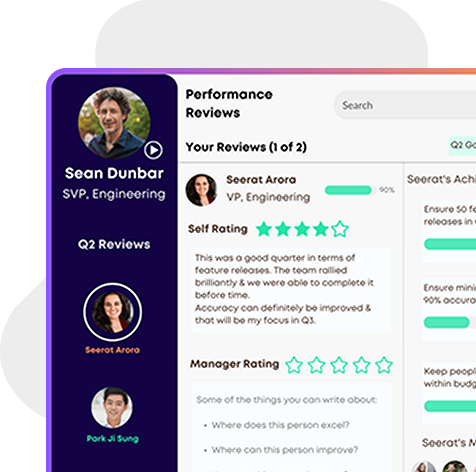
That’s exactly the problem Klaar’s new compensation module is designed to solve, powered by Comprehensive and seamlessly connected to the performance insights already living inside Klaar.
Because when pay reflects performance, employees don't just feel fairly compensated.
They perform wonders.
If you're thinking about how performance data should connect to compensation in your organization, I'd love to hear what you're seeing. Connect with me on LinkedIn so we can keep advancing how performance really works.
With Clarity,
Lana Peters
Chief Revenue & Customer Experience Officer
.svg)
Frequently asked questions


.svg)

.svg)